Smart City Solutions
Modern cities manage tens of thousands of devices across domains that were designed to operate in complete isolation — traffic signals running on proprietary controllers, streetlights on legacy DALI networks, waste bins with no connectivity at all. When these systems can't share data, city operations become reactive: trucks run fixed routes regardless of bin fill levels, lights stay on a fixed schedule regardless of pedestrian activity, and traffic engineers wait for congestion to form before adjusting signal timing. Magistrala provides the IoT platform layer that unifies these fragmented systems without requiring hardware replacement. Multi-protocol ingestion connects devices over LoRaWAN, NB-IoT, Wi-Fi, and wired Ethernet through a single message broker. Domain isolation with fine-grained RBAC ensures that the traffic department's data is separated from waste management while still enabling cross-domain automation rules. Edge computing nodes process sensor data locally for sub-second actuator response — traffic signal adjustments happen at the edge, not after a round-trip to a central cloud. The result is an adaptive city infrastructure that responds to real conditions in real time, reduces operational costs, and generates the auditable data cities need for regulatory reporting and grant compliance.
The Challenge
Cities manage thousands of disconnected systems — from streetlights to waste bins — with no unified data layer, no interoperability, and no way to automate responses across domain boundaries.
Fragmented Infrastructure
Siloed systems built over decades have no interoperability between traffic, lighting, waste, and public safety platforms. Each domain runs its own control software, its own vendor contracts, and its own data format. Integrating them requires custom middleware for every pairing — a maintenance burden that scales with the number of systems, not the number of integrations.
Operational Inefficiency
Fixed schedules waste resources regardless of actual conditions. Waste trucks run full routes even when bins are 20% full. Street lights burn at full intensity at 3 AM. Traffic signals cycle on timers set years ago for traffic patterns that have since shifted. The absence of real-time data makes intelligent automation impossible.
Rising Costs and Citizen Expectations
Growing urban populations strain municipal budgets while citizens expect higher service levels and visible sustainability commitments. Carbon reporting, energy auditing, and service-level agreements with concession operators all require granular, timestamped data that legacy systems simply cannot produce at the required frequency or fidelity.
How it works
From sensor to action
Magistrala unifies diverse urban sensors into a single IoT platform — enabling city-wide automation, cross-domain data sharing, and data-driven decision making without replacing existing hardware.
Connect
Streetlights, waste bins, traffic sensors, and environmental monitors connect over LoRaWAN, NB-IoT, Wi-Fi, or wired Ethernet. Magistrala's multi-protocol adapter layer handles authentication and normalization at the point of ingestion, so new device types can be onboarded without changes to downstream systems.
Aggregate
Multi-protocol ingestion normalizes data from thousands of heterogeneous devices into a unified message schema. Devices are organized into domain-isolated groups reflecting city department structure — traffic, utilities, waste, public safety — with RBAC policies controlling which departments can read or write to which channels.
Automate
Smart rules evaluate cross-domain data and trigger actuator commands: dimming lights based on pedestrian count, rerouting waste trucks when fill levels change, adjusting traffic signal phases based on queue length data from upstream detectors. Rules run at the edge for time-critical actuations and in the cloud for complex multi-source logic.
Visualize
City operators monitor real-time dashboards and historical trend data to identify inefficiencies, validate SLAs, and plan capital investment. Automated reports export data to council reporting systems, grant compliance portals, and ESG dashboards — eliminating manual data collection from department heads.
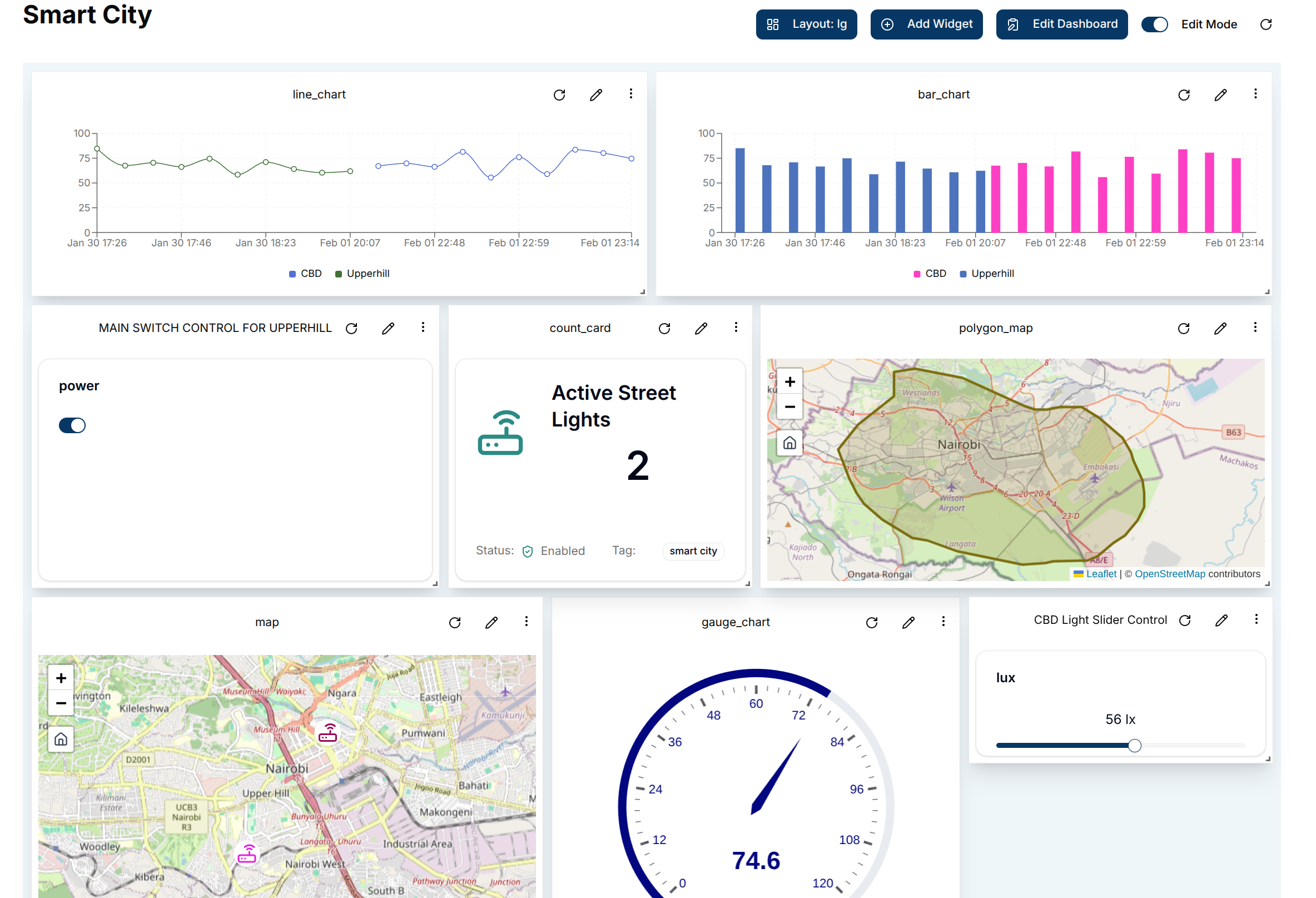
City Operations Dashboard
Unified visibility into every connected asset — from streetlights to waste bins — in a single command center.
Key Applications
Transform every aspect of urban infrastructure with connected IoT solutions built on a single platform.
Adaptive Street Lighting
Luminaires report energy consumption and fault status over LoRaWAN while dimming schedules respond to ambient light sensors and pedestrian motion detectors. Fault detection alerts maintenance teams with pole ID and GPS location — replacing patrol-based inspection with event-driven dispatch.
Smart Waste Management
Ultrasonic fill-level sensors in bins publish readings every 4–6 hours. A route optimization rule triggers a collection request only when a bin exceeds a configurable threshold. Dynamic routing reduces fleet kilometres driven by 20–35% while maintaining service levels defined in city contracts.
Public Safety Integration
Environmental sensors, camera health monitors, and emergency call-point status feed into a unified alert plane. Cross-domain rules trigger coordinated responses — a public address alert correlated with camera activity and lighting changes — without manual coordination between control rooms.
Energy Grid Monitoring
Smart grid integration connects substation sensors and distributed energy resources (solar panels, EV charging points) to a centralized load dashboard. Real-time consumption data supports demand-response programmes and feeds directly into carbon accounting and ESG reporting workflows.
Benefits
Why teams choose Magistrala for smart city solutions
- Reduce traffic congestion by up to 25% with adaptive signal timing driven by real-time vehicle detection data
- Cut street lighting energy costs by 30–50% through motion and ambient light-triggered dimming schedules
- Optimize waste collection routes dynamically — eliminating unnecessary truck runs to bins that are less than 70% full
- Unify siloed city systems under a single device management and access control plane with full audit logging
FAQ
Common questions about smart city solutions
Yes. Magistrala exposes REST and WebSocket APIs that integrate with GIS platforms, ERP systems, and city dashboards such as Esri ArcGIS, SAP, and custom operator interfaces. Webhook sinks push events directly to existing ticketing and dispatch systems without requiring replacement of front-end tools.
Magistrala uses domain-level isolation backed by SpiceDB policies. Each department (traffic, utilities, waste) operates in its own domain with its own device groups, channels, and user roles. Cross-domain data sharing is configured explicitly through policy grants — departments see only what they're authorized to see.
Edge gateway nodes continue local operation and buffer messages using store-and-forward during connectivity interruptions. Time-critical actuations (traffic signals, emergency lighting) execute from edge-cached rules without requiring a cloud round-trip. Buffered telemetry is replayed to the platform on reconnection in timestamp-correct order.
Magistrala is designed for incremental adoption. A pilot deployment connecting a single district's streetlights and waste bins runs on a single-node instance. As additional domains onboard, the platform scales horizontally on Kubernetes. Domains, device groups, and access policies added during the pilot remain valid in the production-scale deployment.
Ready to get started?
Deploy Magistrala in minutes with our free tier, or talk to our team about an enterprise solution tailored to your needs.