Smart Water Metering
Water utilities globally lose between 20–40% of treated water to distribution network losses — a combination of physical leaks, unauthorized connections, and metering errors collectively called non-revenue water (NRW). Traditional fixed-schedule meter reading creates a 30-to-90-day gap between a leak occurring and its detection. During that window, a single failed joint in a transmission main can waste thousands of cubic meters while billing systems show nothing unusual. Pressure transients from pump starts and valve operations stress aging pipe joints, accelerating failures that compound across the network. Magistrala transforms this reactive model by connecting every meter, pressure logger, and flow sensor into a continuous data stream — giving operations teams real-time visibility into network behavior and enabling automatic, rule-based alerts before losses escalate. Devices connect via MQTT over NB-IoT, LoRaWAN, or cellular. The built-in rules engine evaluates telemetry in real time for minimum night flow anomalies, pressure wave signatures, and consumption outliers. When a threshold is breached, alerts fire automatically to SCADA systems, field-team ticketing, and SMS gateways — with GPS coordinates and anomaly context included.
The Challenge
Water utilities face growing pressure to reduce losses and demonstrate sustainability. Legacy metering infrastructure creates multi-week blind spots between reads — enough time for a single burst main to waste hundreds of thousands of liters before anyone notices a problem.
No Continuous Visibility
Most distribution networks operate on 30-to-90-day reading cycles. Between reads, operators are blind to consumption patterns, pressure fluctuations, and early-stage leaks. Night-flow analysis — the most reliable leak indicator — is impossible without continuous, timestamped data from every district metered area simultaneously.
Slow Incident Response
When issues surface through customer complaints or billing anomalies, the leak or tampering event has typically been active for weeks. Repair teams face uncertain localization — digging at estimated positions rather than responding to a GPS-correlated alert. Average response times measured in days create exponential water loss curves.
Direct Revenue Loss
Industry benchmarks put global NRW costs at over $39 billion annually. For a mid-sized utility serving 500,000 connections, a 5% NRW reduction translates directly to avoided production, treatment, and energy costs — typically $2–4M per year. Undetected tampering and bypassed meters compound billing shortfalls every quarter.
How it works
From sensor to action
Magistrala connects water infrastructure end-to-end — from field sensors to operations teams — through a fully automated, real-time data pipeline that requires no custom middleware.
Ingest
Field meters and pressure loggers publish telemetry via MQTT through NB-IoT, LoRaWAN, or cellular gateways. Magistrala handles connection management, X.509 or pre-shared key authentication, and automatic reconnection. Each device is registered in the client registry with its DMA assignment and calibration coefficients, so every message arrives pre-tagged with network topology context.
Normalize
Protocol adapters translate raw device payloads — which vary by manufacturer and firmware version — into a normalized SenML or JSON schema. Unit conversions, timestamp corrections, and manufacturer-specific encoding are resolved at the adapter layer so downstream analytics work against a consistent format regardless of hardware mix in the field.
Analyze
The embedded IoT platform rules engine evaluates incoming telemetry against configurable thresholds and cross-device patterns in real time. Minimum night flow anomaly detection, pressure wave correlation for burst events, and consumption ratio comparisons against historical baseline all run as streaming evaluations — no data export to an external analytics platform required.
Act
Triggered rules publish alerts to configurable sinks: SCADA webhooks, field-team ticketing systems, SMS gateways, and email. Alert payloads include device ID, GPS coordinates, anomaly type, severity score, and a direct link to the relevant dashboard — giving field crews everything needed to prioritize dispatch without a second lookup.
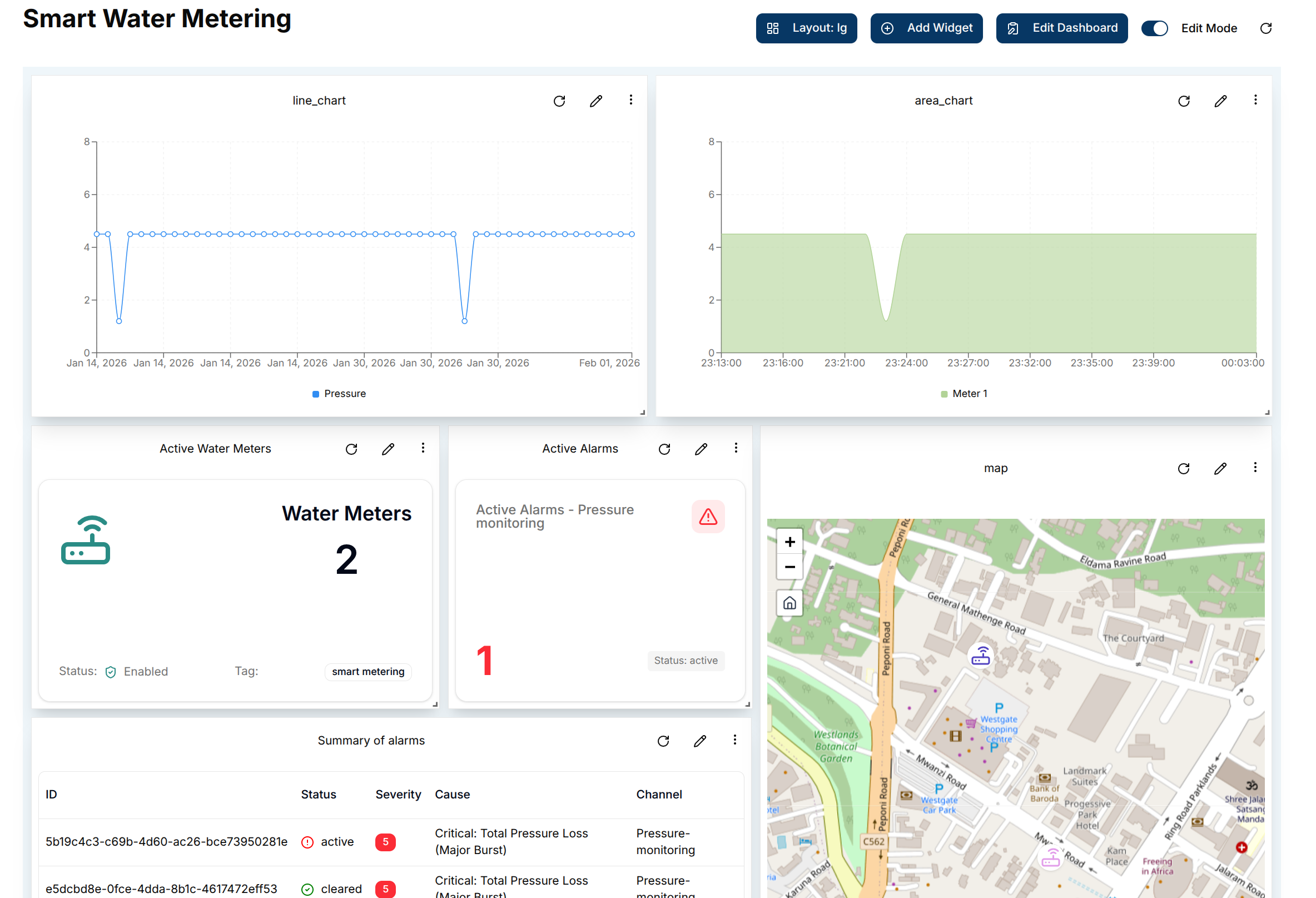
Real-Time Water Network Dashboard
Monitor consumption, pressure, and anomalies across your entire water network from a single pane of glass.
Key Applications
Comprehensive monitoring and control across the water distribution lifecycle.
Consumption Monitoring
Sub-hourly consumption profiles for every registered meter enable demand peak identification, growth scenario modelling, and tariff validation. Aggregated district metered area views support regulatory reporting with no manual data extraction.
Leak Detection
Minimum night flow analysis runs continuously across all DMAs simultaneously. Statistical outlier detection flags zones where night consumption exceeds expected background — typically within 15 minutes of a leak exceeding 0.1 L/s. Burst events trigger immediate high-priority alerts with estimated location from pressure-sensor correlation.
Demand Forecasting
Historical consumption time-series combined with weather and calendar inputs feed short-term demand models used for pump scheduling and reservoir management. Accurate 24-hour forecasts reduce pumping energy costs by optimizing fill schedules against off-peak tariff windows.
Alert Management
Multi-step rule chains allow escalating alert paths: an anomaly triggers a field check request; if unacknowledged within a configured window, it escalates to operations management. Per-device sensitivity tuning and grouped notifications for spatially clustered events prevent alert fatigue.
Benefits
Why teams choose Magistrala for smart water metering
- Reduce non-revenue water by 15–30% within 12 months through continuous DMA monitoring and automated leak localization
- Cut average leak detection time from 45+ days (scheduled reading cycle) to under 4 hours
- Eliminate manual meter-reading routes — saving 2–3 FTE per 50,000 connections
- Achieve regulatory NRW reporting compliance with automated daily and monthly data exports
FAQ
Common questions about smart water metering
Magistrala's ingestion layer accepts MQTT over NB-IoT, LoRaWAN (via ChirpStack or TTN integration), GPRS/LTE cellular, and wired Ethernet. Devices authenticate with pre-shared keys or X.509 certificates. Gateways can aggregate readings from local AMI meshes and forward over any available backhaul without requiring changes to meter firmware.
Yes. Magistrala exposes a webhook-based alert sink and a REST API for time-series data retrieval. Most SCADA platforms consume webhook POST calls or poll the Magistrala API directly. For OPC-UA-based SCADA systems, an adapter exposes Magistrala channels as OPC-UA nodes — keeping existing operator interfaces unchanged.
Magistrala implements fine-grained RBAC via SpiceDB, scoped to domains, groups, and individual channels. A field technician can be granted read-only access to their assigned DMA while a billing analyst has export access to consumption data but no alarm management permissions. All access changes are logged with full audit trails.
A single-node Docker Compose deployment handles approximately 10,000 connected meters at 15-minute reporting intervals. For larger networks, Kubernetes deployment with horizontal scaling of the ingestion and rules engine services handles millions of messages per hour. Magistrala is also available as a managed cloud service, eliminating infrastructure management entirely.
Ready to get started?
Deploy Magistrala in minutes with our free tier, or talk to our team about an enterprise solution tailored to your needs.