Industrial Gateway Integration
Manufacturing facilities and process plants have accumulated decades of automation investment: PLCs from the 1990s running Modbus RTU over RS-485, SCADA systems polling OPC-DA servers, proprietary fieldbus devices that predate TCP/IP entirely. These systems work reliably in isolation but are architecturally cut off from modern cloud infrastructure — creating a fundamental barrier to remote monitoring, data-driven maintenance, and operational analytics. Magistrala solves the industrial connectivity problem through protocol-translating edge gateways that sit between legacy fieldbus networks and the cloud, with no changes required to existing control systems. Gateway devices run Magistrala's edge agent, which polls Modbus registers or subscribes to OPC-UA nodes at configurable rates, converts readings into MQTT messages, applies local filtering and aggregation, then forwards normalized telemetry to the Magistrala platform over TLS. At the platform layer, device management handles certificate rotation, firmware update orchestration, and connection health monitoring across hundreds of gateways simultaneously. The rules engine runs ML-derived failure signatures as streaming evaluations — detecting vibration frequency shifts, thermal drift, and power factor degradation patterns that precede equipment failure by days or weeks. Maintenance workflows trigger automatically before failures occur, converting unplanned downtime into scheduled interventions.
The Challenge
Factories run on legacy equipment that speaks protocols the cloud has never heard of. Without a translation layer, operational data stays locked in fieldbus networks — making predictive maintenance, remote monitoring, and production analytics impossible.
Protocol Silos
Industrial equipment communicates over Modbus RTU/TCP, OPC-UA, Profinet, BACnet, and DNP3 — none of which integrate natively with cloud IoT platforms. Building one-off adapters per vendor is expensive, fragile, and impossible to maintain at scale across a multi-site estate with hundreds of different device models.
Reactive Maintenance
Without continuous monitoring, equipment failures are discovered only after production stops. The average unplanned downtime event in process manufacturing costs $260,000 per hour in lost output, labor, and restart costs. Maintenance teams operate on fixed calendar schedules or respond to breakdowns — neither approach uses the performance data the equipment is already generating.
No Edge Intelligence
Sending raw PLC data to the cloud creates millisecond-level latency for time-critical decisions, bandwidth costs that scale linearly with polling frequency, and a single point of failure for any local automation that depends on cloud responses. Production systems cannot tolerate the latency or reliability constraints of pure cloud architectures.
How it works
From sensor to action
Magistrala bridges legacy industrial protocols to the cloud using a gateway-first architecture — keeping existing control systems untouched while enabling real-time analytics and predictive maintenance across every connected asset.
Translate
Edge gateway devices running Magistrala's agent connect to fieldbus networks via Modbus RTU/TCP, OPC-UA, BACnet IP, or Profinet. Polling schedules, register maps, and unit conversions are configured per device class and pushed remotely from the platform. Translated readings are published as MQTT messages tagged with asset ID, facility, and timestamp.
Process at the Edge
Local compute on the gateway applies configurable pre-processing: time-window averaging for slow-changing process variables, FFT computation for vibration signatures, threshold evaluation for immediate local alarms. Only events and derived metrics that exceed relevance criteria are forwarded to the cloud — raw high-frequency samples are processed and discarded locally.
Monitor
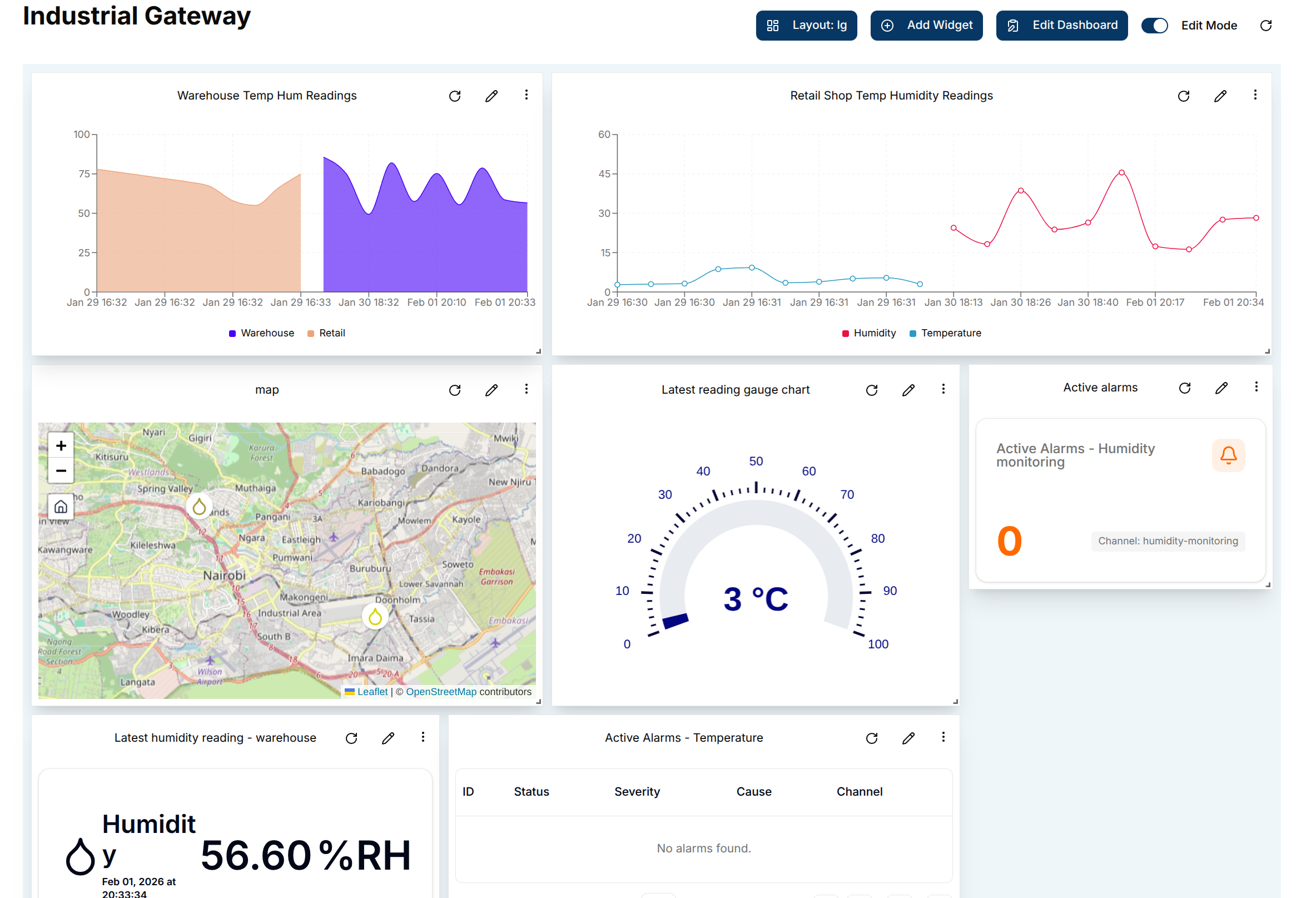
Normalized telemetry streams into Magistrala's time-series storage and feeds real-time dashboards showing equipment health scores, production counters, energy consumption, and environmental conditions across all facilities simultaneously. Custom views per role ensure that a plant engineer sees asset-level detail while a VP of Operations sees site-level KPIs.
Predict
ML models trained on historical failure data evaluate incoming telemetry as streaming feature vectors. When a model's risk score for a specific asset exceeds a configured threshold, the rules engine fires a maintenance work order to the CMMS, notifies the responsible engineer, and logs the prediction with supporting evidence for post-maintenance review.
Industrial Monitoring Dashboard
Centralized monitoring of connected gateways, equipment health, and production metrics across all facilities.
Key Applications
Bridge the gap between legacy industrial equipment and modern cloud infrastructure without disrupting existing control systems.
Protocol Translation
Edge gateways poll Modbus registers, subscribe to OPC-UA nodes, and read BACnet objects at configurable rates — then publish normalized MQTT messages to Magistrala. Translation mappings are configured per device type and deployed remotely via the platform's device management API, with no gateway reboot required.
Predictive Maintenance
Vibration FFT signatures, thermal imaging data, motor current draw, and operating hour counters feed ML models that detect degradation patterns — bearing wear, rotor imbalance, insulation breakdown — days or weeks before failure thresholds are reached. Maintenance work orders generate automatically in CMMS systems when risk scores exceed defined limits.
Edge Computing
Local compute on gateway hardware runs aggregation, filtering, and time-windowed analytics before transmission. High-frequency sensor data (vibration at 10 kHz) is processed locally into spectral features; only the derived metrics — not raw samples — are forwarded to the cloud. This reduces bandwidth by 70–90% while preserving analytical fidelity.
Secure Connectivity
Every gateway authenticates to Magistrala with a device-specific X.509 certificate issued through the platform's PKI. All data in transit uses TLS 1.3. RBAC policies restrict which cloud users and applications can access which facility's data. Certificate expiry, revocation, and renewal are managed centrally from the device management console.
Benefits
Why teams choose Magistrala for industrial gateway integration
- Eliminate OT/IT data silos by translating Modbus, OPC-UA, BACnet, and Profinet into cloud-native MQTT without touching control system logic
- Reduce unplanned downtime by 40–60% through ML-driven predictive maintenance detecting failure signatures weeks in advance
- Cut edge-to-cloud bandwidth by 70–90% using local aggregation and threshold-triggered transmission on gateway nodes
- Enforce end-to-end security with TLS/mTLS on all connections, X.509 device certificates, and per-facility RBAC policies
FAQ
Common questions about industrial gateway integration
No. Magistrala's edge agent connects to Modbus and OPC-UA interfaces that PLCs and SCADA systems already expose for HMI and historian connectivity. The gateway reads as a passive client — no ladder logic changes, no new function blocks, no SCADA alarm configuration changes. Existing control systems are unaware of the gateway's presence.
Gateways initiate outbound TLS connections to Magistrala over a dedicated DMZ or cellular backhaul — no inbound firewall rules are required on the OT network. Communication is strictly unidirectional by default (telemetry upload only). Bidirectional command channels for remote configuration require explicit policy enablement and are scoped to specific gateway management topics.
Yes. Each facility is modelled as a separate Magistrala domain with its own device groups and access policies. Gateway configuration is managed per device class — a Siemens S7 PLC and an Allen-Bradley ControlLogix at the same site use different translation mappings but route to the same platform. Multi-site dashboards aggregate across domains with role-appropriate data visibility.
Magistrala's rules engine evaluates models deployed as ONNX binaries or as rule expressions using built-in statistical functions (rolling averages, standard deviation, FFT peak detection). For more complex models, the platform forwards feature vectors to external ML inference endpoints via HTTP, then uses the response score in downstream rule evaluation.
Ready to get started?
Deploy Magistrala in minutes with our free tier, or talk to our team about an enterprise solution tailored to your needs.