Smart Irrigation
The Smart Irrigation pack gives farms and managed landscapes a live view of soil conditions, water flow, and tank levels across multiple field zones. Soil moisture sensors, weather stations, flow meters, smart valves, and a pump controller all land in pre-built dashboards with detection rules and scheduled reports already wired up. When soil moisture drops below the wilting threshold at 3 AM, the alarm fires and the email goes out before the crop is stressed.
Six detection rules monitor the field around the clock — catching dry soil before crops reach wilting point, waterlogging before root damage sets in, pipe bursts before significant water is lost, and low tank levels before the pump runs dry. Valve and pump control sit directly on the dashboard so operators can respond without leaving the monitoring view.
Why Magistrala
Your existing field sensors probably already speak one of our protocols, so there is nothing to replace in the field. All ten device types — soil sensors, weather stations, flow meters, valves, tank sensor, pump — connect to the same Telemetry Channel and flow through the same rules. One Zone Monitoring template scales to any number of irrigation zones without duplicating configuration. Soil health and water consumption reports go out automatically every week.
Platform dashboards
See it in action
Purpose-built dashboards for every layer of your smart irrigation deployment — from live telemetry to compliance reports.
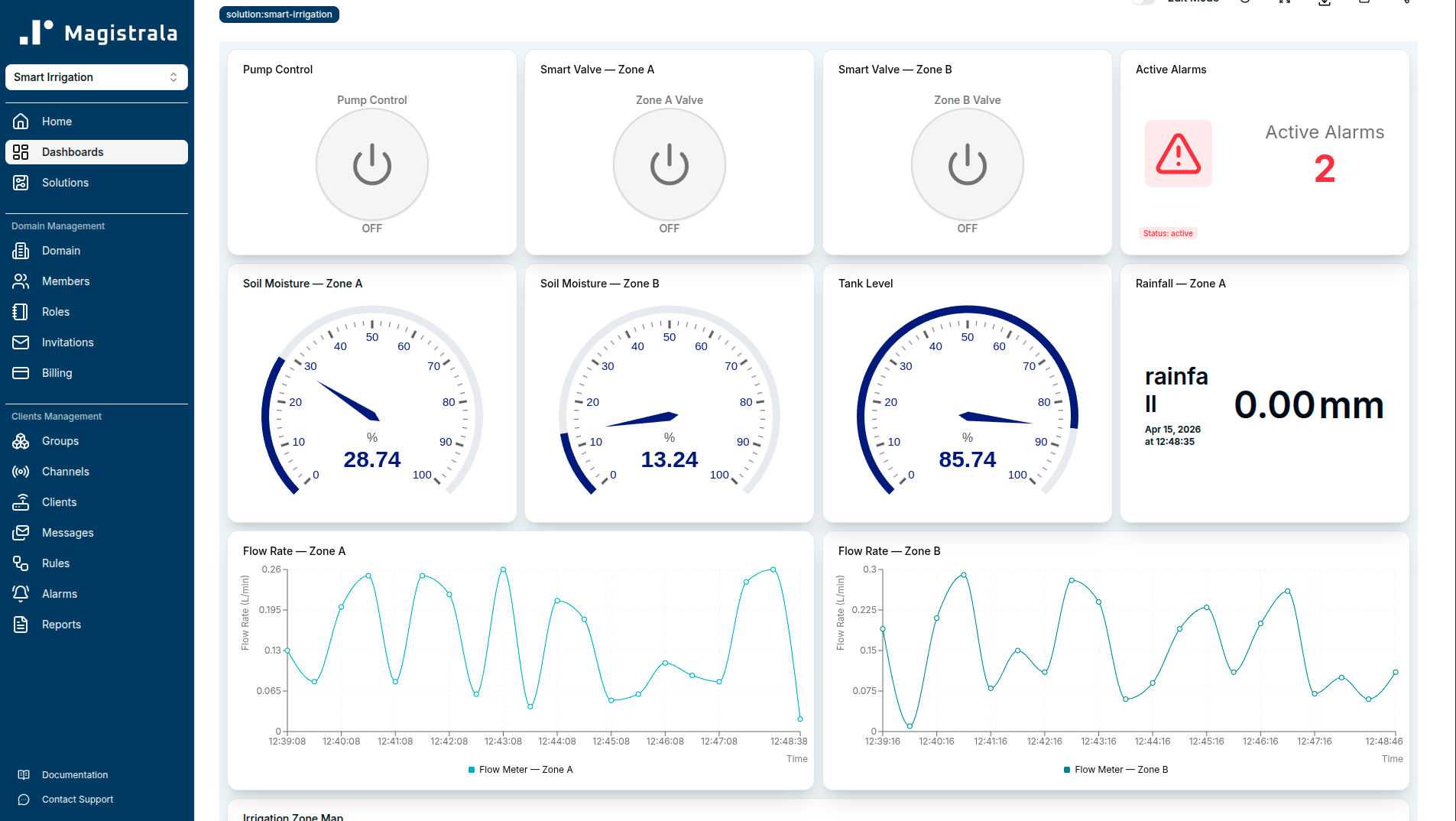
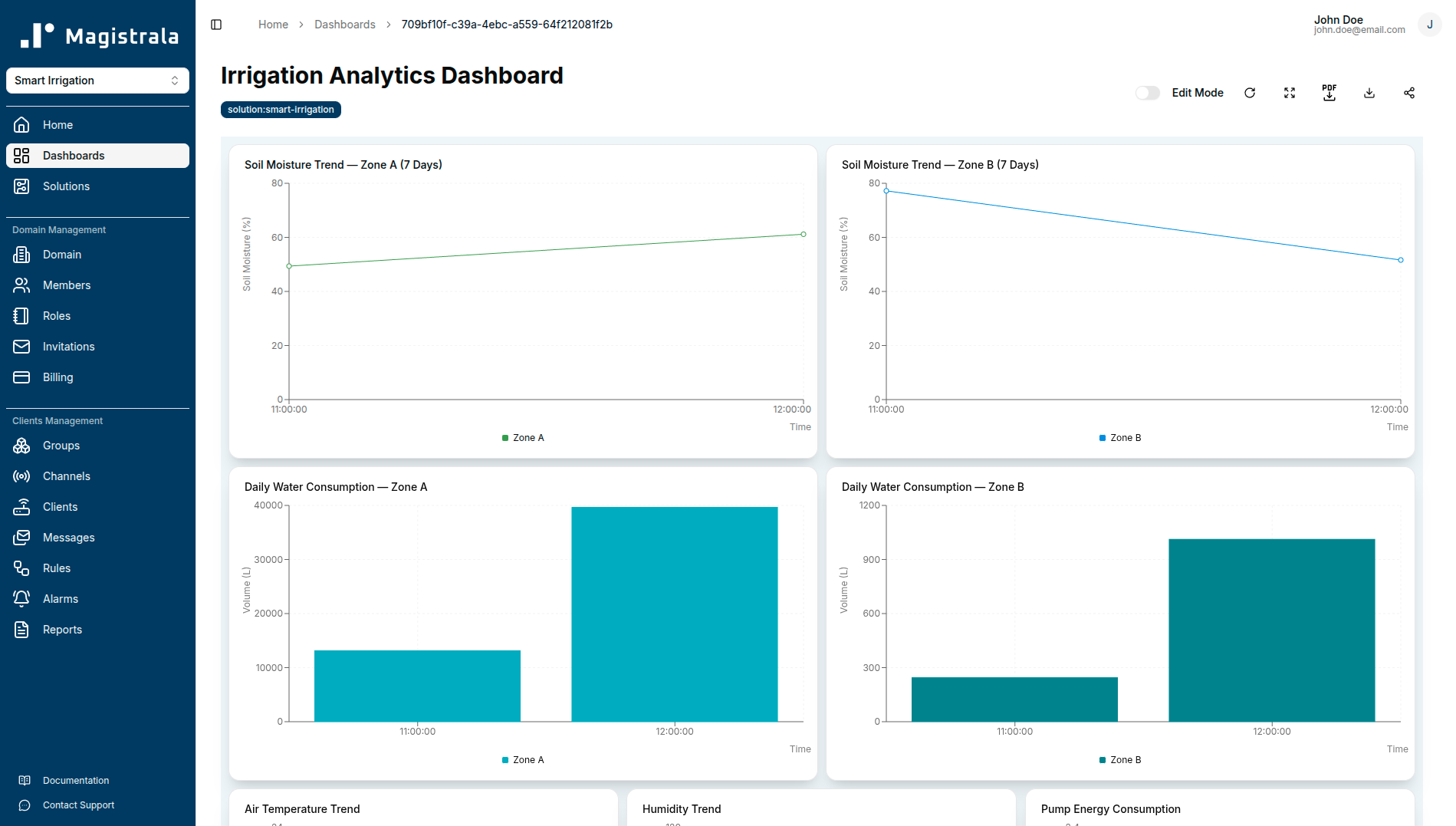
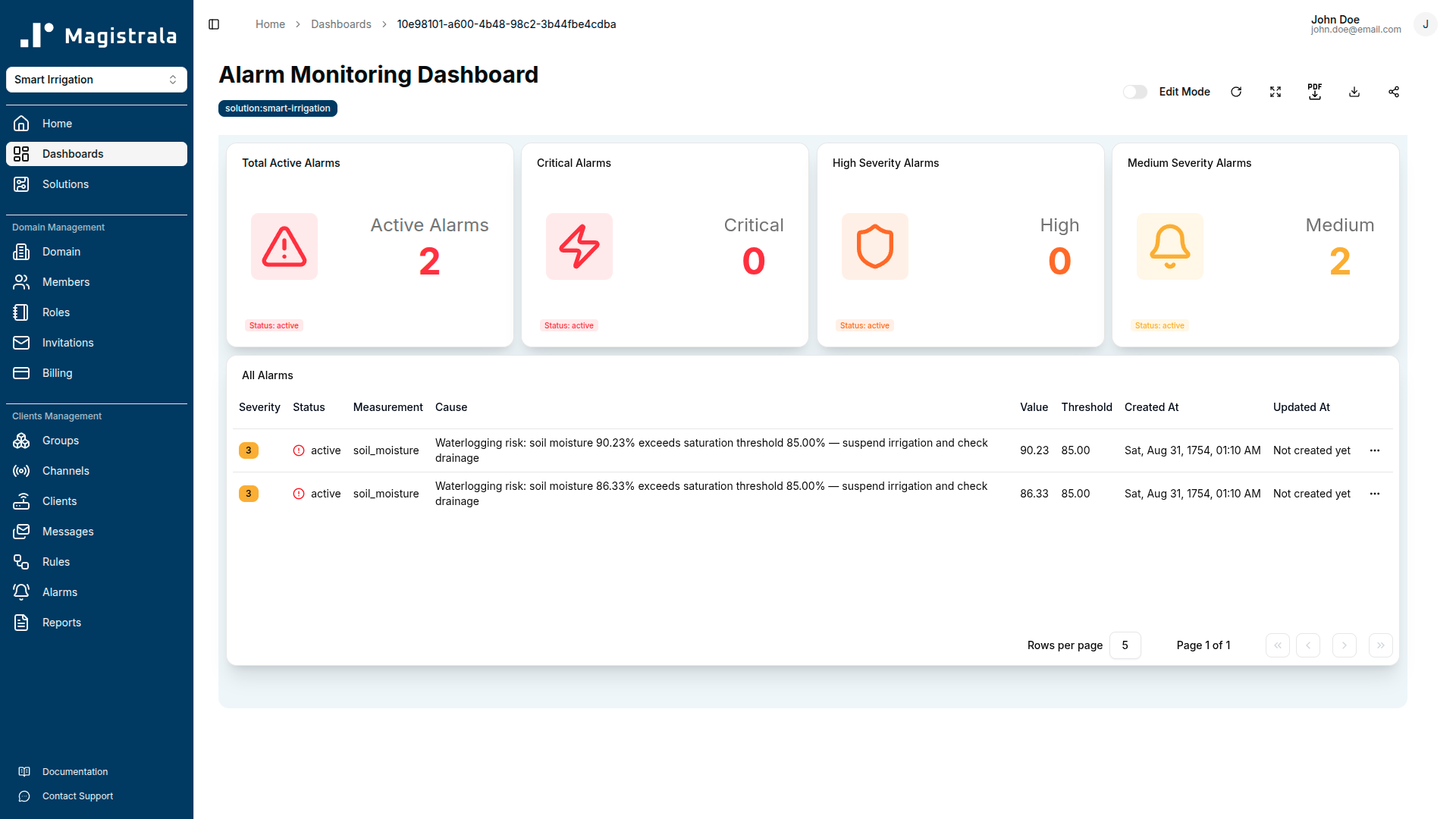
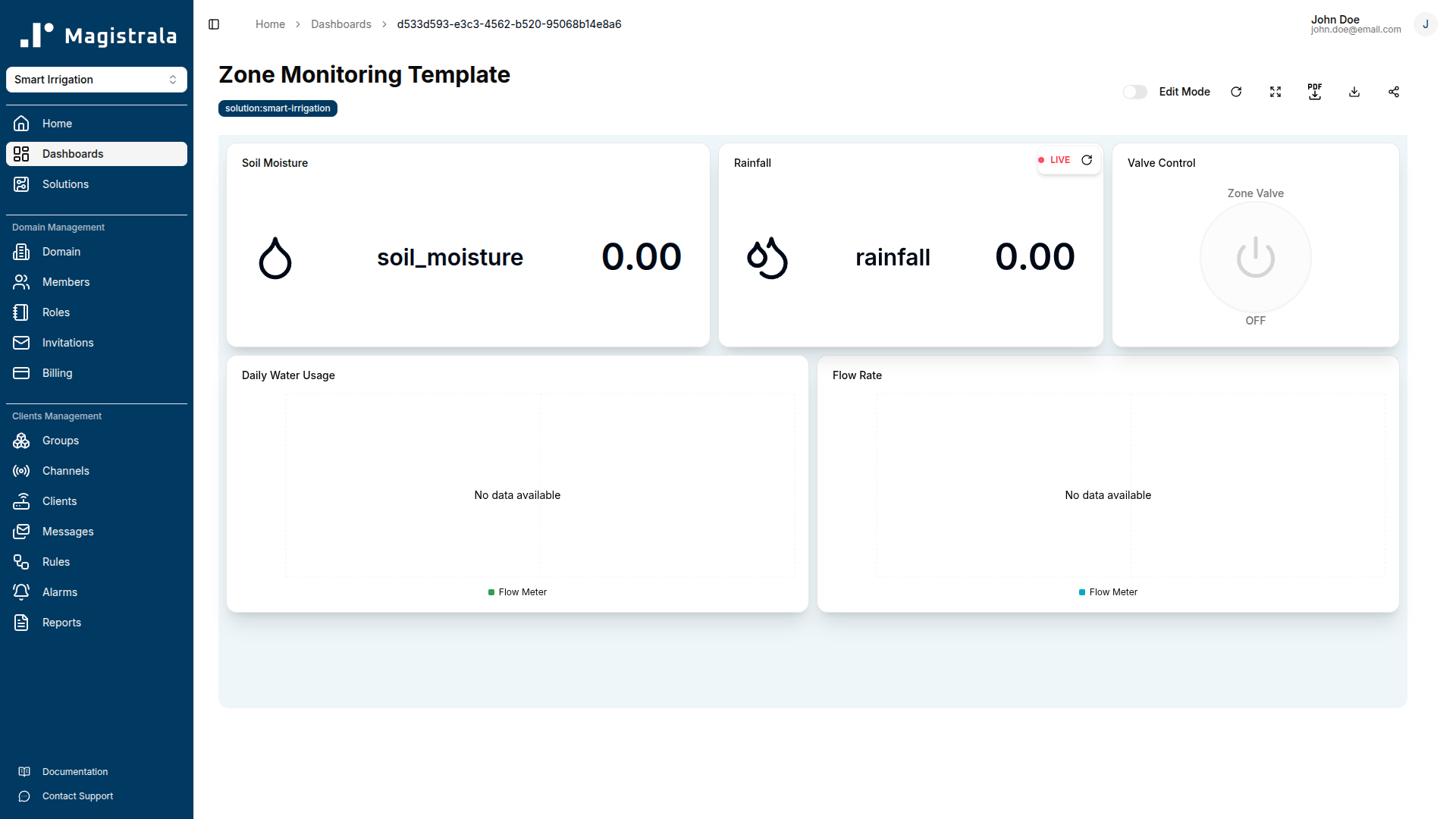
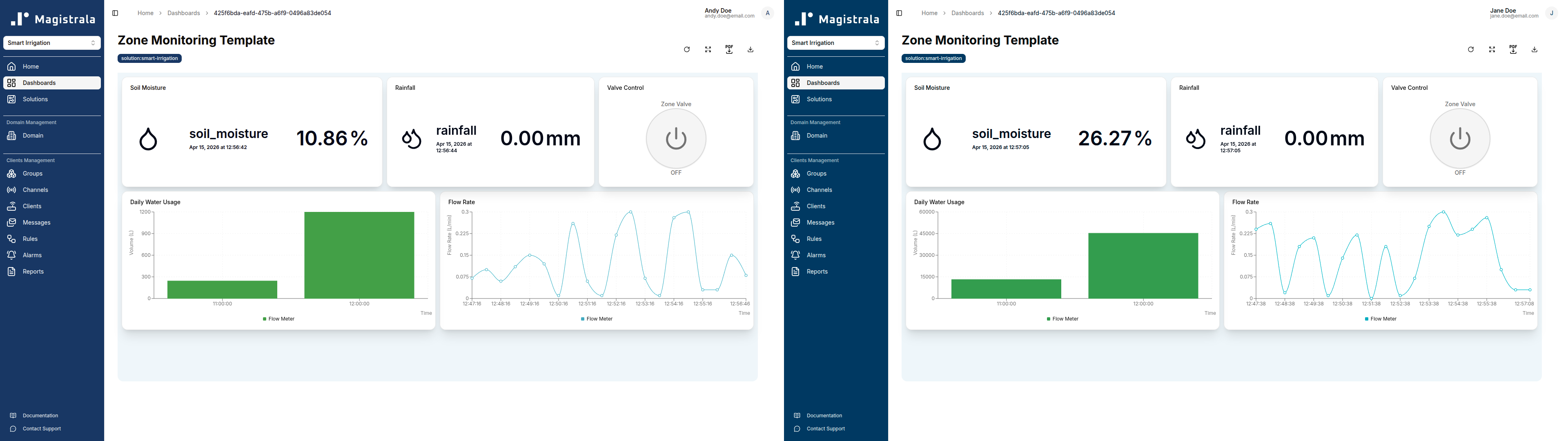
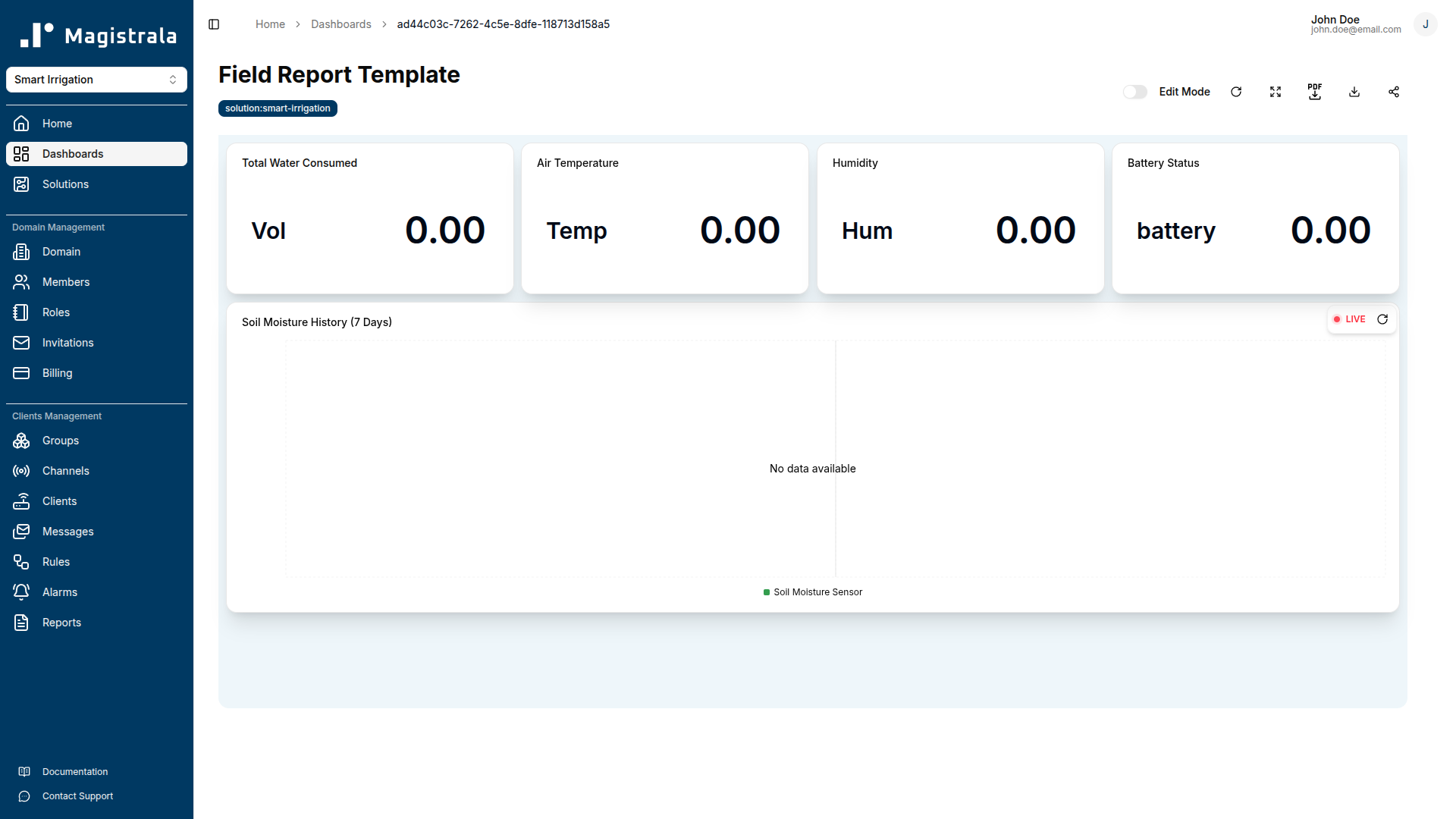
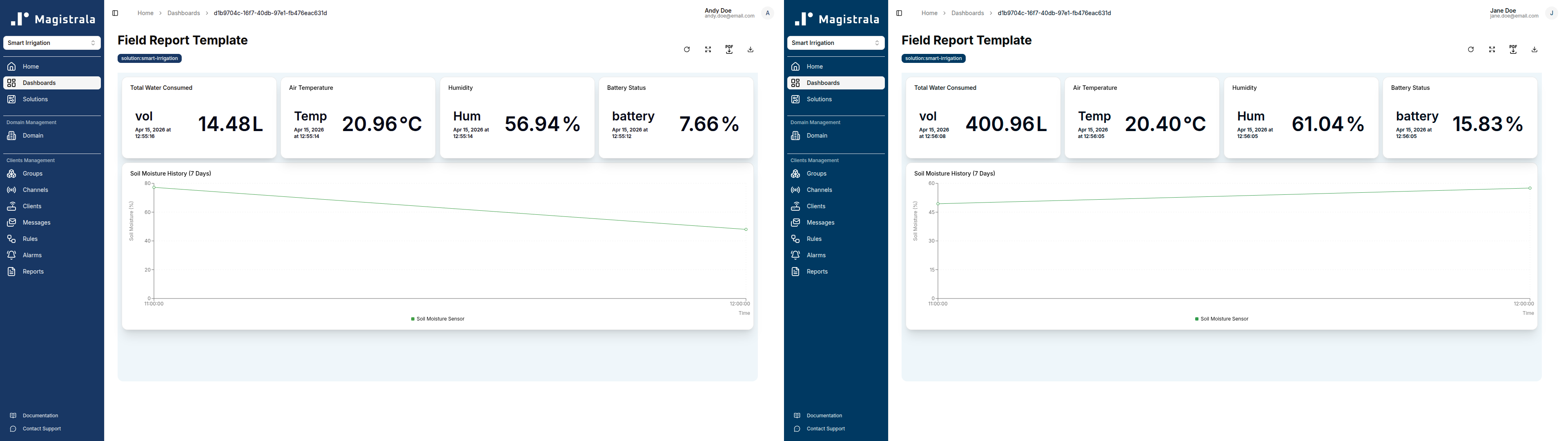
Field Operations Dashboard with zone soil moisture gauges, flow charts, tank level, and valve control switches
The challenge
Problems farms deal with every season
The agronomic and financial costs of reactive irrigation management add up. These are the specific pain points the solution pack addresses.
Finding out about burst pipes from wet ground, not telemetry
A burst irrigation pipe in the early hours drains the tank, wastes water, and can leave an entire zone unirrigated. The alarm should fire before the water is gone.
No visibility into how much water each zone is actually using
Without zone-level flow data, water budgets are estimates at best. Comparing consumption against scheduled volumes is a spreadsheet job done after the fact.
Soil health reports assembled manually every week
Pulling moisture and temperature readings from sensors, averaging them per zone, and formatting the output for the agronomist. Every single week, by hand.
How it works
From sensor to action
Four steps from field sensor to actionable decision
Ingest
Soil sensors, weather stations, flow meters, valves, and the pump controller publish SenML readings over MQTT, HTTP, CoAP, or WebSocket. Every raw reading is saved immediately to the Telemetry Channel.
Detect
Six rules watch the incoming data continuously. Moisture drops below 35%? Dry soil warning. Flow spikes above 40 L/min? Pipe burst alarm. Tank below 25%? Refill warning. Rainfall above 2 mm? Schedule review alert.
Control
Valve and pump switches on the Field Operations Dashboard send commands directly to actuators via the Commands Channel. Operators respond without leaving the monitoring view or opening a separate control interface.
Report
Daily water consumption, weekly soil health, and monthly water efficiency reports go out automatically by email. Long-term moisture and volume trends feed into seasonal irrigation planning.
Key Applications
Where farms and land managers deploy smart irrigation monitoring
Arable farming and precision crop irrigation
Zone-level soil moisture drives irrigation decisions rather than fixed schedules. Dry soil alarms fire before crops are stressed. Daily volume reports close the loop on water spend.
Vineyard and orchard water stress management
Soil moisture at canopy depth tells you when vines or trees are drawing on reserves. Irrigation runs only when needed. Waterlogging alarms prevent root rot during wet spells.
Multi-zone landscape and turf management
Golf courses, sports grounds, and municipal parks monitor each irrigation zone independently. Zone managers see only their assigned area. Pipe burst alarms prevent overnight water loss.
Shared farmland and tenant irrigation accounts
Each farmer sees their own field's moisture history, water consumed, and device battery status through the Field Report template. Aggregate consumption and alarm data stay with the farm manager.
Benefits
Why teams choose Magistrala for smart irrigation
The solution pack removes the integration work — so your team can focus on outcomes, not infrastructure.
- Dry soil alarms fire within seconds of threshold breach — before crop stress develops, not after a field inspection the next morning
- Pipe burst alarms trigger at 40 L/min, giving operators time to close the zone valve before the tank drains and the pump runs dry
- Zone-level total volume data closes the gap between water budget targets and actual consumption without manual data collection
- Weekly soil health reports aggregate daily average moisture and temperature per zone and deliver automatically — no manual data assembly
- Monthly water efficiency reports combine zone volume and pump energy into a single PDF for water cost and budget reconciliation
- Tag-based Zone Monitoring and Field Report templates scale to any number of zones or farmer accounts from a single template definition
- Valve and pump control from the Field Operations Dashboard reduces response time to soil or flow alarms without requiring a separate control system
FAQ
Smart Irrigation — Frequently Asked Questions
Yes. The sensors do not need to speak MQTT or HTTP directly. A local gateway — an edge controller, industrial IoT gateway, or a Raspberry Pi running a small adapter — can read your sensors via their native interface and publish SenML payloads to the Telemetry Channel. Many commercial agriculture gateways support RS-485 Modbus, SDI-12, and other field bus protocols out of the box. As long as the gateway delivers correctly formatted SenML records, the detection rules and dashboards work identically to a native MQTT sensor.
Yes. The solution ships with two zones (Zone A and Zone B), but the architecture scales to any number. Each additional zone needs its own device clients, a group for access control, and connections to the Telemetry and Commands channels. The Zone Monitoring template scales automatically — assign it to any group containing devices tagged with the correct zone device tags and it renders the right data without any template changes. Detection rules apply to all telemetry in the Telemetry Channel, so new zone devices are covered by the same rules immediately after connection.
Detection rules evaluate each SenML message as it arrives, so alarm latency equals the device's publish interval. For soil moisture monitoring where conditions change gradually, publishing every 5–10 minutes is adequate. For flow meter and pipe burst detection where conditions can change in seconds, publishing every 30–60 seconds gives operators a window to respond before significant water is lost. Battery reporting is not time-sensitive — once per hour is sufficient for the Low Battery Alert to be useful without generating unnecessary network traffic.
Yes. The pack is agnostic to the irrigation delivery method. Drip and sprinkler systems both use flow meters to report `flow_rate` and `total_volume`, so the High Flow Alert, daily consumption report, and Irrigation Analytics Dashboard work the same way for both. The main difference is the normal flow rate range: a drip system running at 2–5 L/min will have a lower typical `flow_rate` than a sprinkler running at 15–22 L/min. You may want to lower the pipe burst threshold in the High Flow Alert rule to match your drip system's actual flow profile — the default of 40 L/min is calibrated for sprinkler systems.
Try the Smart Irrigation Solution Pack
Preconfigured clients, channels, rules, dashboards, reports, and alarms — ready in minutes on Magistrala Cloud.